Stock management
Online stock management that updates itself
An online stock management system that runs off the documents you already raise. Switch Enable stock management on from the product page and let the work do the counting: finalised documents take stock out, purchases put it back in, and you are notified before a product runs short.
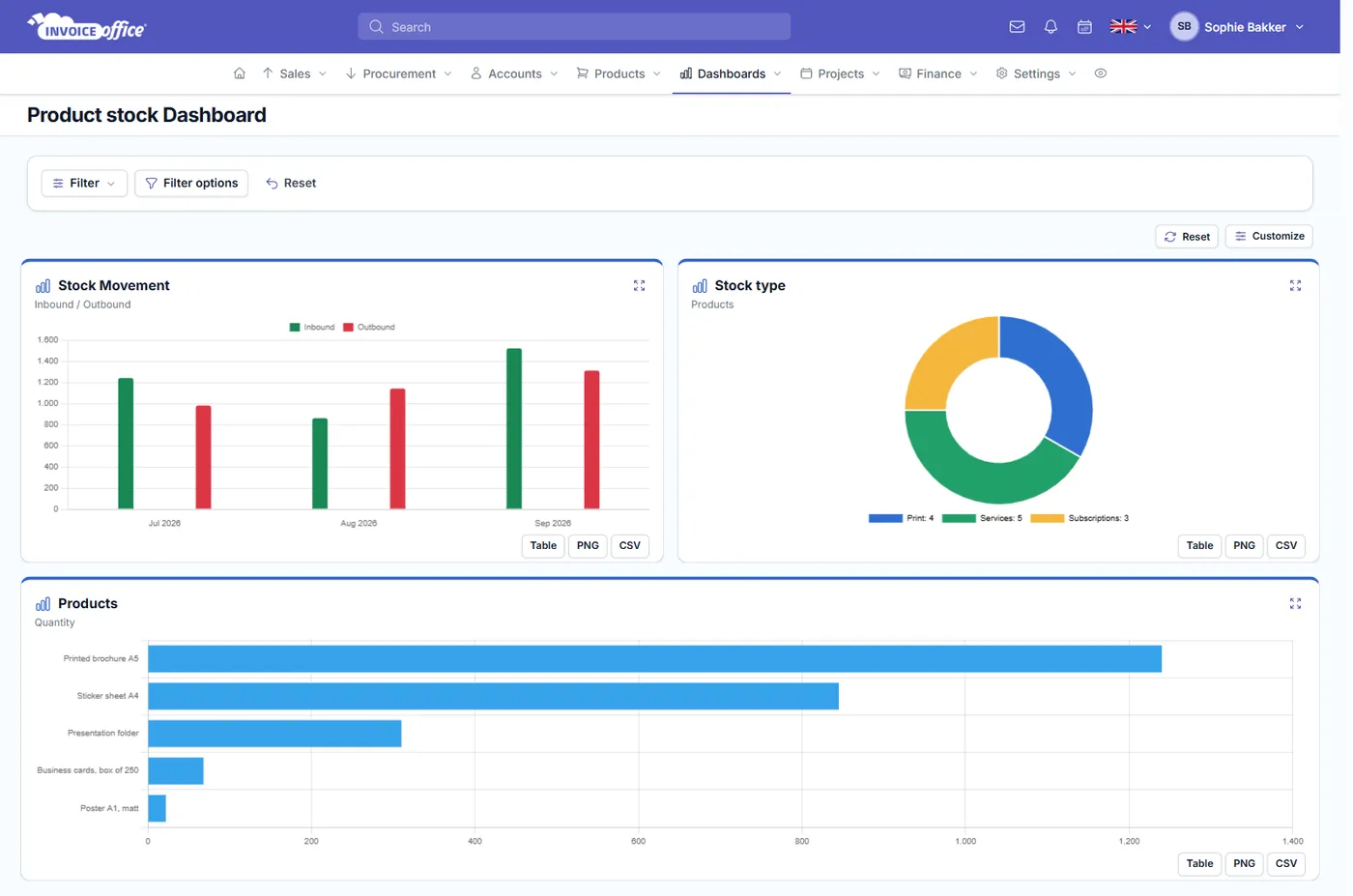
Everything on your stock
Real-time visibility, no manual counting
Stock figures go wrong when keeping them right is somebody’s job. Wire the movements to the documents and purchases that cause them and the count looks after itself.
Enable stock management per product
Enable stock management is a single switch on the product page. From that point the product carries its Stock quantity, its Stock location and its Minimum stock, with no separate system to keep in step.
Documents reduce stock automatically
Stock reduction lets you choose which document types take stock out for a product. As soon as a document of that type is finalised or sent, the products on it come off the level. Inbound documents — credit notes and purchases — always put stock back regardless of that list.
Purchases bring stock back in
A purchase is the receipt of goods, so registering one recalculates the level for each product on it. A purchase order is only a promise to a supplier and deliberately never moves stock — the purchase it becomes is what does.
Stock workflow status
A stock-managed product carries a Stock workflow status alongside its quantity, with its own history, so where an item has got to in your process is recorded on the product rather than tracked in someone’s head. The status history is part of the Pro license.
Every movement on the record
Stock mutations list the full history of a product’s movements, from purchases through to hand-made corrections, and export to PDF, Excel or CSV when you need them elsewhere. A stock dashboard adds KPIs and charts across the whole catalog.
Add stock mutation by hand
Add stock mutation corrects a discrepancy whenever the shelf and the system disagree. The change is recorded in Stock mutations alongside every automatic movement, so a hand correction is as auditable as the rest.
What you track
Four things per product
Switch tracking on and a product starts carrying everything needed to answer the only questions that matter: how much have I got, where is it, and when should I buy more? It all lives on the same product record, and it is your purchases that put stock back on the shelf.
Stock quantity
The live count of what you hold, moving as documents are finalised and purchases are registered — so the number on screen is the number in the building.
Stock location
Record where a product physically sits. Once entered, the Stock location can also be printed on packing notes and pick lists, so whoever picks the order is told where to find it.
Minimum stock
Set the level a product should not fall below. That threshold is what turns a stock figure into a decision about when to reorder.
Automatic notification
When stock reaches the Minimum stock level you receive a notification automatically, so a shortage is something you head off rather than discover when an order cannot be filled.
How it works
Set it up once, then just check it
Step 1Enable it on the product
Switch Enable stock management on for the products that need it, then set the Stock location and the Minimum stock level you want to be notified at.
Step 2Let your documents move it
Pick the document types under Stock reduction. Sales take stock out as those documents are finalised or sent; purchases put it back in as they are registered.
Step 3Review and correct
Read Stock mutations to see every movement on a product, and use Add stock mutation whenever a physical count disagrees with the system.
Stock management questions, answered
How do I start tracking stock for a product?
Does stock update automatically when I send a document?
Do purchases update my stock levels?
Can I get alerts when stock runs low?
Can I record where stock physically sits?
How do I correct a stock discrepancy?
Does stock management need a paid plan?
More answers in our FAQ and help center.
Related
What moves your stock
Know what you have, always
With our software we make the lives of entrepreneurs easier. Free to start, and 14 days free on every paid plan.