Keeping track of product stock tells you what you actually hold rather than what you think you hold. In Invoice Office, stock is managed per product, on the product’s own Stock tab.
Open the stock settings for a product
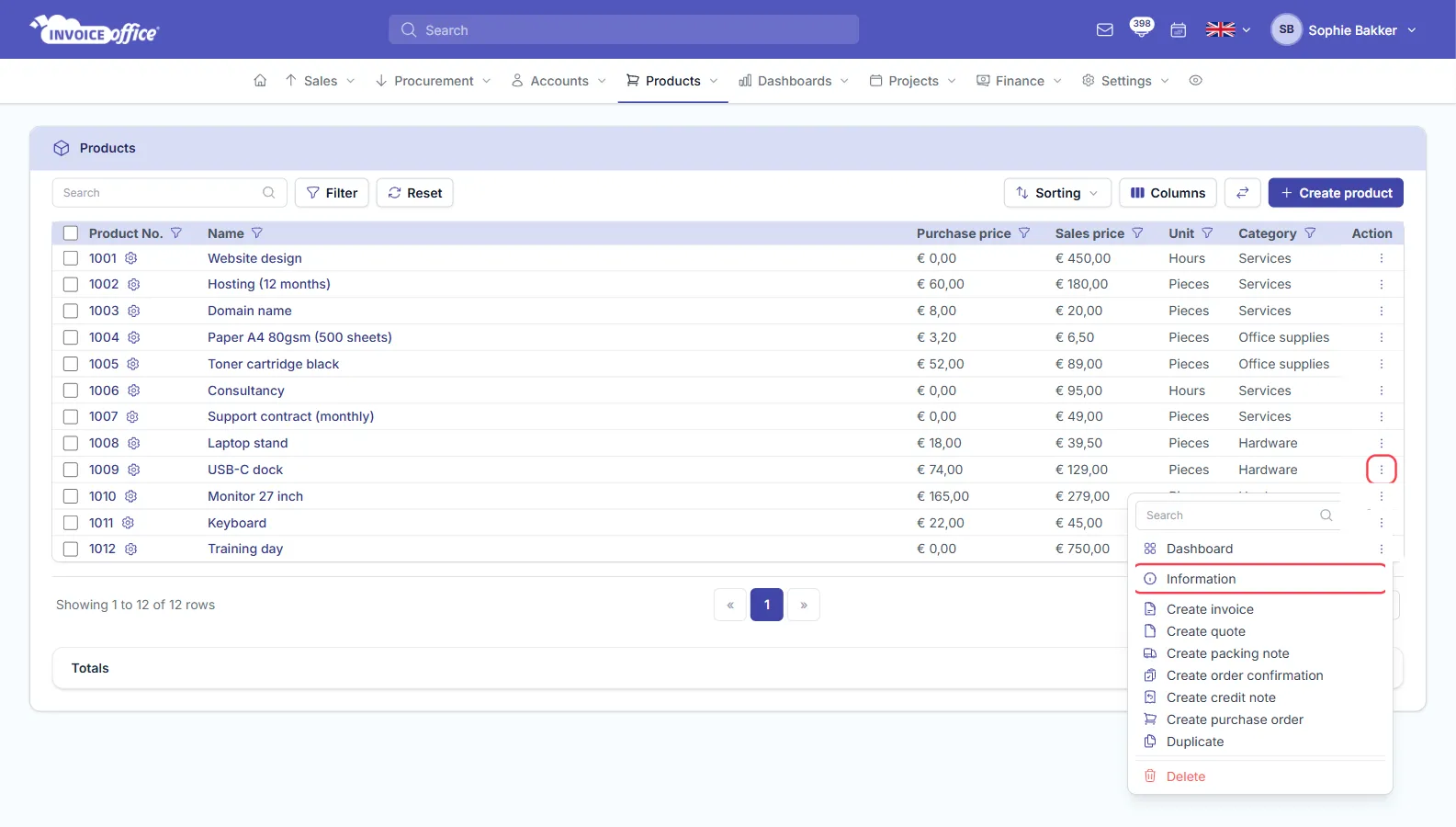
- On your dashboard, go to Products → Products.
- Find the product you want to track, open its Action menu (the ⋮ at the end of the row) and choose Information. The ⓘ icon beside the product number goes to the same place — the product name itself opens the product’s Dashboard, not the form.
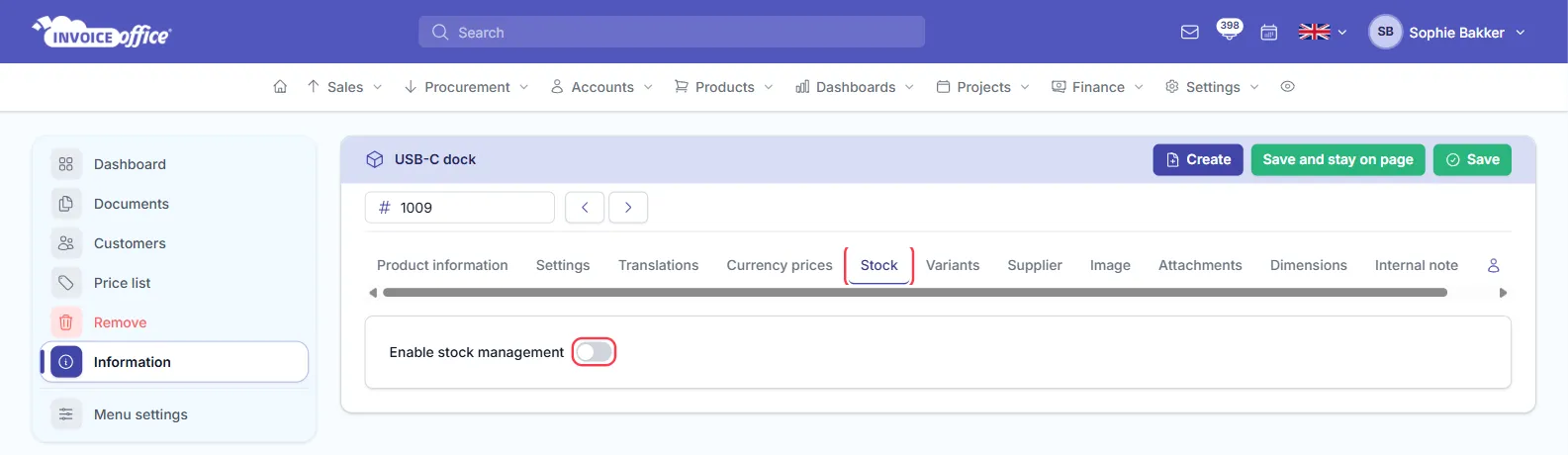
- On the product form, open the Stock tab and switch on Enable stock management. Until you do, the tab holds nothing but that switch.
New to products? See Creating and managing products first.
Products you do not stock — services, hours, digital goods — can be left with stock switched off.
What you can set
Switching the toggle on reveals the whole tab:
- Stock quantity — the actual stock position for this product. Update it here.
- Minimum stock — the level at which you want to be notified that stock is running down, so you can replenish it in time.
- Stock location — the warehouse location for this product. Once entered, it can also be shown on your packing notes and pick lists.
- Stock reduction — the document type that reduces the stock: Invoice, Order confirmation, Packing note, Proforma invoice or Quote. As soon as a document of that type is finalized or sent, the products on it come off the stock level. Pick the one that matches the point in your process where the goods actually leave.
- Stock type — Stocked Product, Non-stocked Product, Serialized Product or Service.
- Workflow status — the status of the current stock position and its transition to another state, with Stock workflow status and History buttons beside it.
- Delivery date, Due date and a Description for your own notes.
When the numbers are right, click Save in the top right corner.
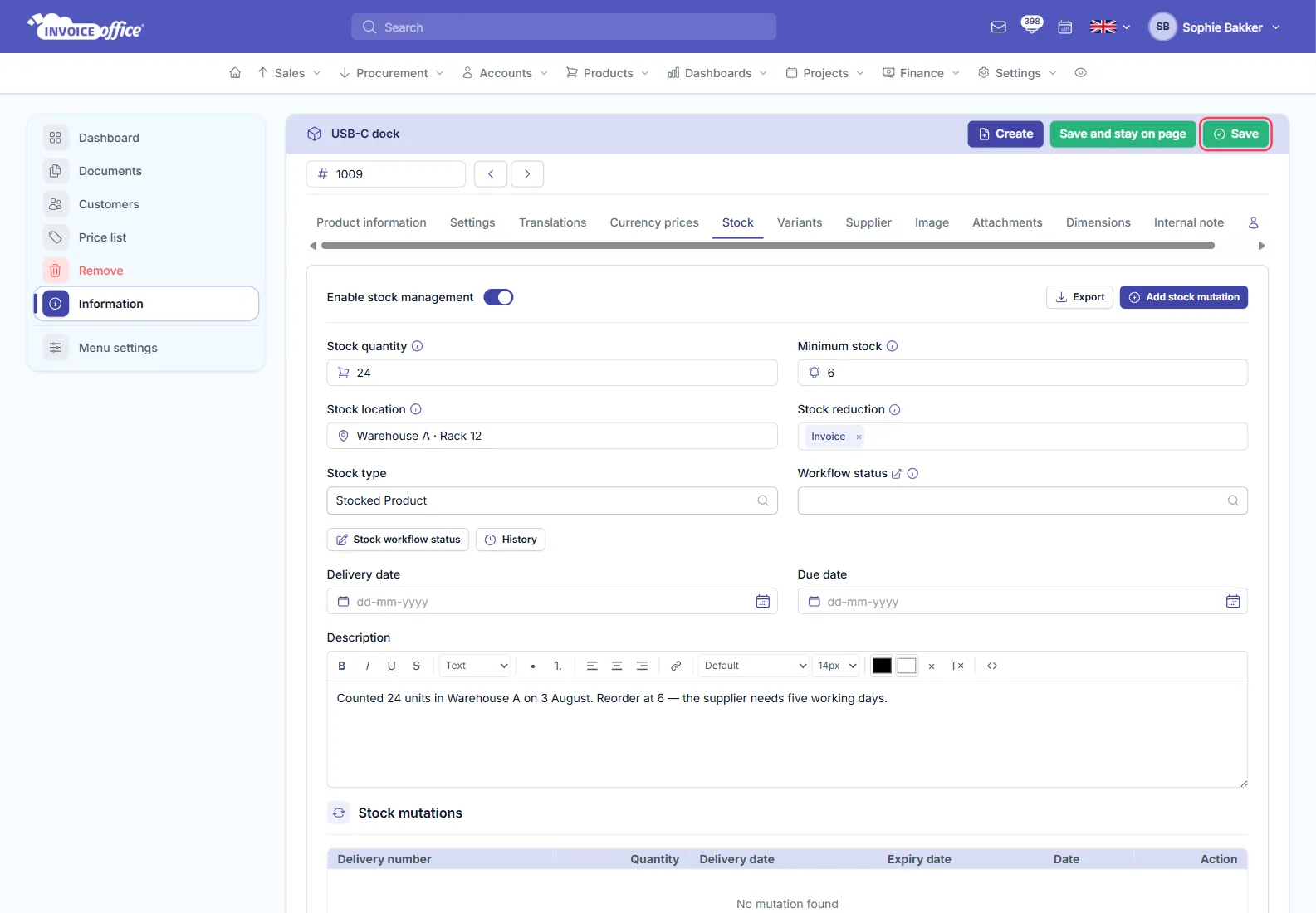
Every movement is logged under Stock mutations at the bottom of the tab — delivery number, quantity, delivery date, expiry date and date. Add stock mutation records one by hand (a delivery you took in, a correction after a count), and Export downloads the list.
For the whole catalogue at once, Dashboards → Stock charts stock movement, stock per type and the quantity held per product. See Stock management for what that covers.
Keeping it accurate
- Start from a real count. Stock tracking is only as good as the opening number you enter.
- Set a realistic minimum. Pick a level that gives you enough time to reorder and take delivery, not the point at which you run out.
- Match the stock reduction to your process. If you ship before you invoice, reduce on the packing note; if the invoice is the moment goods leave, reduce on the invoice.
- Count periodically. Even a good system needs an occasional physical check, and a stock mutation to record what you found.
Any doubts? Contact us and we will help.