Document data is everything around the product table: the addresses, the customer number, the VAT number, the delivery date, your references. It varies per customer and per invoice, so you decide which of it your documents show — add what you need, remove what you never fill in.
Switch a block on or off
- Go to Settings → Document designs, pick the language and open the design.
- Switch to Document template.
- In the blocks list on the left, use each block’s switch to show or hide it.
- Click Save.
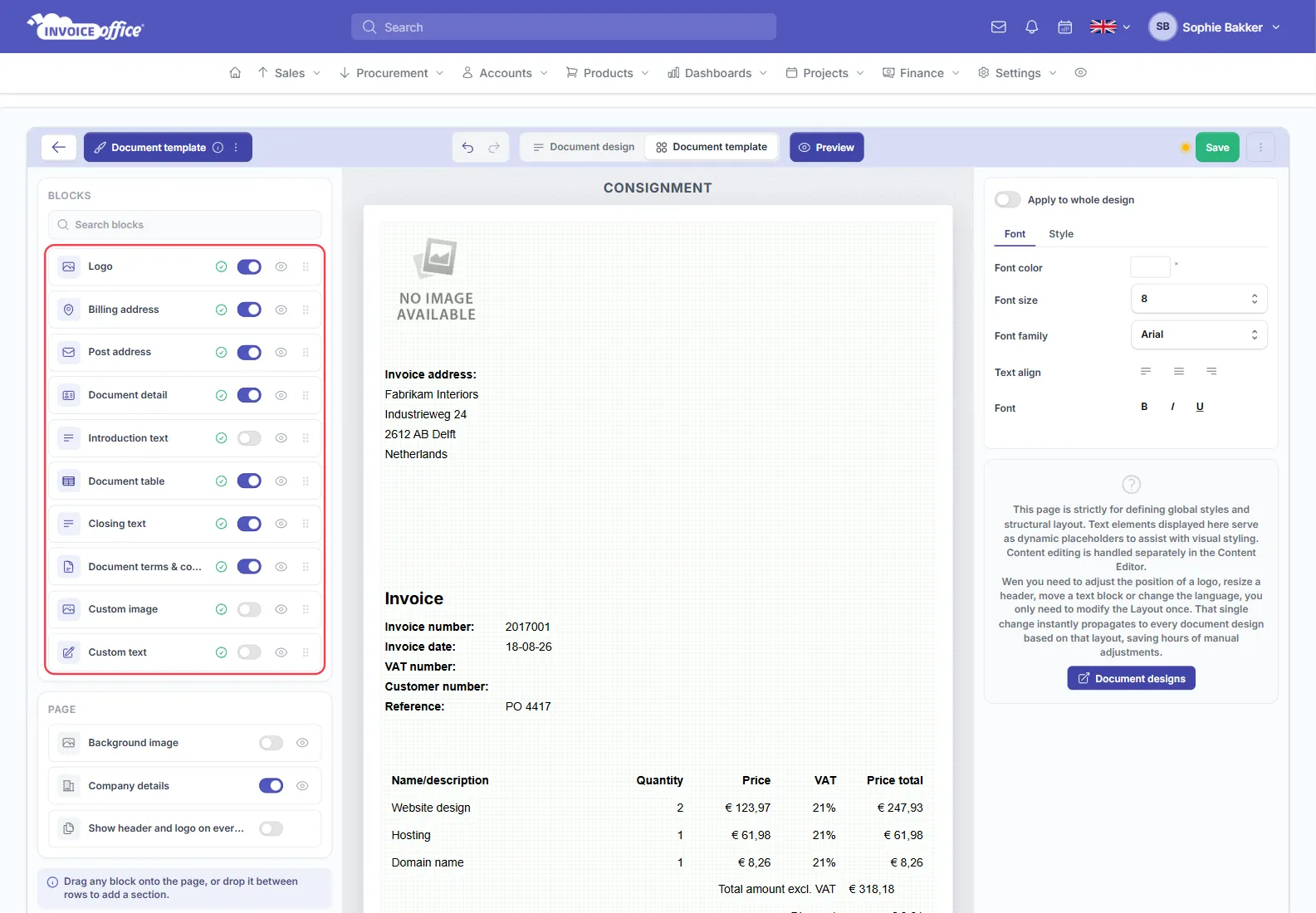
The blocks are the whole document: Logo, Billing address, Post address, Document detail (the invoice number, dates, references and customer number), Introduction text, the Document table, Closing text, Document terms & conditions, and a Custom image and Custom text for anything of your own.
Below them, PAGE holds Background image, Company details — the footer strip — and Show header and logo on every page.
The eye beside each switch isolates that block in the preview, which is the quickest way to find which block a stray line belongs to. The handle on the right drags a block into a new position.
Choose the table’s columns
Click the document table in the preview and its Content tab lists the specification columns — Name/description, Quantity, Price, VAT, Price total — each with a width slider that starts on Auto.
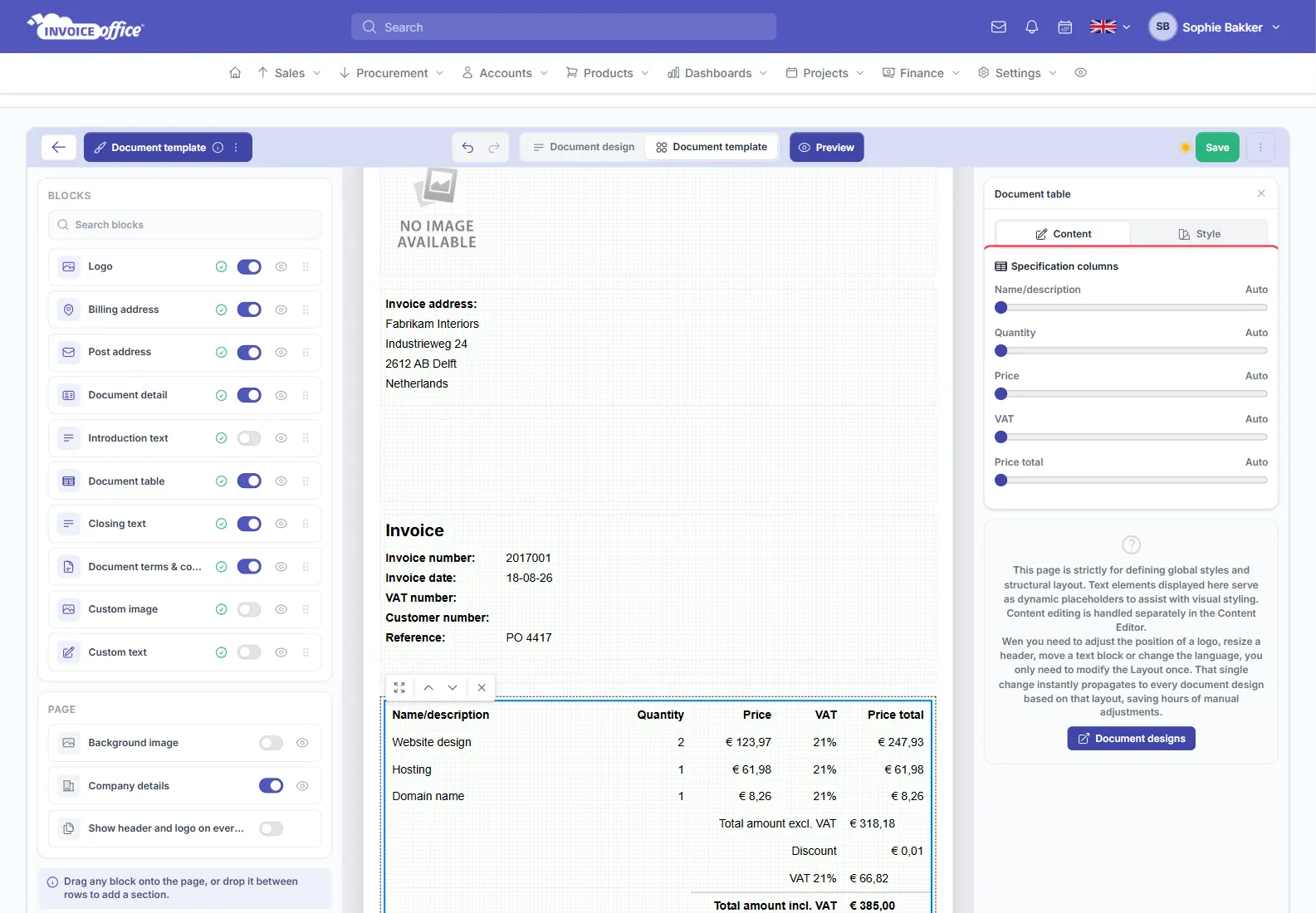
Leave the widths on Auto unless a column is squeezing another; drag one and the rest reflow.
Getting it right
- Only keep what you use. An empty “Your reference” or “Delivery date” line on every invoice adds clutter and makes the document harder to scan.
- Keep what your customer’s accounts department asks for. A customer number, order reference or VAT number is often what gets an invoice approved quickly, so leave those on if they are requested.
- Check a real document, not the editor. Use Preview after saving to see how the block actually sits on the page.
- Blocks belong to the template. Switching one off changes every design built on that template — which is usually what you want, and occasionally a surprise.
A field is empty on the document
If a block is switched on but a line inside it stays blank, the data is missing on the record it comes from — a VAT number that was never filled in on the customer, or a delivery date left empty on the invoice. Fill it in there and it appears on the document.
To change what a field is called rather than whether it shows, see How to change the label name.
Any doubts? Contact us and we will help.