Peppol e-invoicing requirements by country differ a lot within the EU. In Belgium, Peppol is already mandatory for business-to-business invoices; in the Netherlands it’s required for invoices to the government; Germany requires structured e-invoices but not Peppol itself; and Italy has its own national system, SdI. This guide covers the Netherlands, Belgium, Germany and Italy: what is mandatory, which format is used, which deadlines apply — and what Invoice Office supports in each country.
The rules below are the state of play in November 2026. E-invoicing rules change often, so check the dates with your accountant or tax adviser before you rely on them.
At a glance
| Country | Mandatory today | Coming up | Format and network | In Invoice Office |
|---|---|---|---|---|
| Netherlands | Invoices to the government (B2G) | Domestic B2B e-invoicing planned from 1 July 2030 — not law yet | Peppol BIS 3.0 or SI-UBL over Peppol | Send and receive over Peppol, including to government (OIN) |
| Belgium | Domestic B2B since 1 January 2026 | E-reporting to the tax authority planned from 2028 | Peppol BIS 3.0 over Peppol | Send and receive over Peppol |
| Germany | Receiving B2B e-invoices since 1 January 2025; B2G e-invoices | Issuing B2B e-invoices from 2027 (turnover over €800,000) and 2028 (all) | EN 16931: XRechnung, ZUGFeRD; Peppol allowed, not required | Register and receive over Peppol; no German customer IDs yet |
| Italy | B2B, B2C and B2G e-invoices through SdI since 2019 | — | FatturaPA XML through SdI — not Peppol | Not supported |
Netherlands: mandatory for government, voluntary for B2B
- Government (B2G). Invoices to the Dutch central government go over Peppol since 2017, and other public bodies followed. Government bodies are addressed by their OIN (Organisatie-identificatienummer).
- Business to business (B2B). E-invoicing is voluntary, but common. The Dutch cabinet has announced a domestic B2B e-invoicing obligation from 1 July 2030, with digital reporting a year later; businesses under the small business scheme (KOR) are to be exempt. The bill isn’t law yet, and whether Peppol becomes the required network hasn’t been decided — though it’s the expected basis (peppol.nu, eConnect).
- Format. Peppol BIS Billing 3.0, or the Dutch SI-UBL (SimplerInvoicing) profile.
In Invoice Office: a Dutch company registers on Peppol with its KvK number and VAT number. You can address Dutch customers by KvK number, VAT number or — for government bodies — their OIN. For SimplerInvoicing, pick it as your UBL protocol (see below).
Belgium: B2B e-invoicing over Peppol since 2026
- Mandatory since 1 January 2026. VAT-registered businesses in Belgium must send and receive structured e-invoices for domestic B2B sales. Peppol is the default network and Peppol BIS 3.0 the standard format; a PDF by email no longer counts as an invoice between Belgian businesses. After a tolerance period in the first months of 2026, fines apply (European Commission, EY).
- Coming up: e-reporting from 2028. Belgium plans near-real-time reporting of invoice data to the tax authority, over Peppol, from 1 January 2028 (EDICOM).
In Invoice Office: a Belgian company registers with its enterprise (BCE/KBO) number and VAT number. Switch on both outgoing and incoming invoices in the Peppol connector, because you must be able to receive too. Address Belgian customers by Belgium BCE/KvK number or Belgium VAT number; the enterprise number is preferred. UBL.BE Invoice 3.0 - Belgium is available as a UBL protocol.
Germany: e-invoices required, Peppol optional
- Receiving: mandatory since 1 January 2025. Every German business must be able to receive B2B e-invoices.
- Issuing: from 2027 and 2028. From 1 January 2027, businesses with a previous-year turnover over €800,000 must issue B2B e-invoices; from 1 January 2028, all businesses must (European Commission, EDICOM).
- Format, not network. An e-invoice must follow the European standard EN 16931 — in practice XRechnung (pure XML) or ZUGFeRD (a PDF with embedded XML). Germany doesn’t require a specific network: Peppol is one way to deliver, email is another.
- Government (B2G). Invoices to public bodies must be e-invoices, usually XRechnung, addressed by the authority’s Leitweg-ID; federal authorities also accept delivery over Peppol.
In Invoice Office: a German company can register on Peppol with its VAT number and receive e-invoices over Peppol. The customer Peppol identifier list has no German type yet, so you can’t send an invoice over Peppol to a German customer from Invoice Office. Invoice Office doesn’t create XRechnung or ZUGFeRD files either.
Italy: SdI and FatturaPA, not Peppol
- Mandatory since 2019 for everyone. Italy requires electronic invoices for B2B, B2C and B2G transactions between parties established in Italy. Every invoice goes through the tax authority’s Sistema di Interscambio (SdI) in the FatturaPA XML format.
- Peppol isn’t the route. For domestic invoices, FatturaPA through SdI is required and Peppol can’t replace it (Invoice Navigator). Italy uses Peppol formats for purchase orders to public bodies (through its NSO order hub) and connects to Peppol for cross-border public procurement — not for everyday invoicing (Thomson Reuters).
In Invoice Office: Italian e-invoicing isn’t supported. Invoice Office doesn’t create FatturaPA files or connect to SdI, and a company based in Italy can’t register on Peppol. If you invoice Italian customers from another country, the rules of your own country apply: send them a normal invoice, or a Peppol invoice if they have a Peppol ID.
Check what Invoice Office supports for your customers
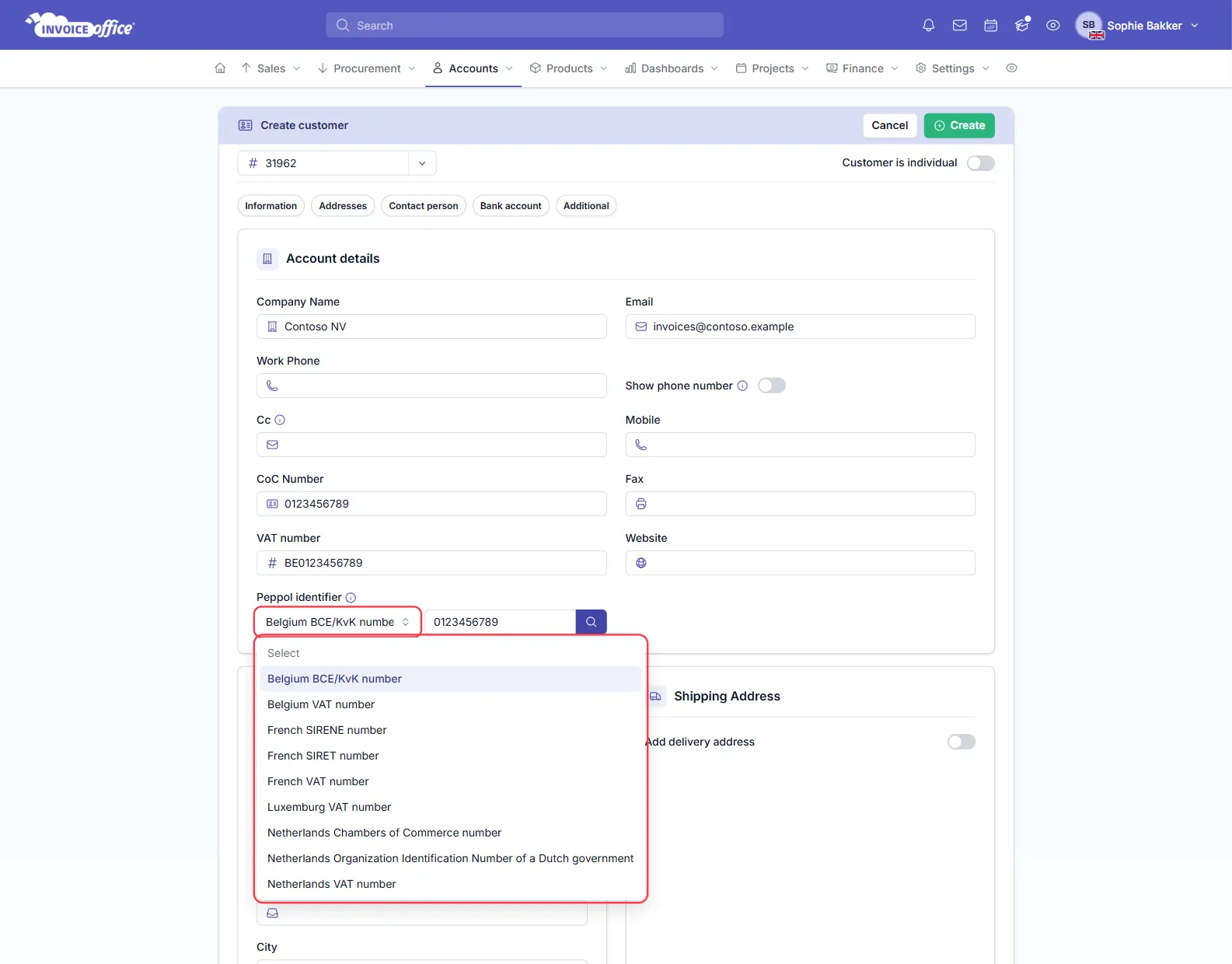
The countries you can send to over Peppol are the countries in the Peppol identifier list on a customer. Open a customer in Accounts → Customers and look under Account details: Belgium, France, Luxembourg and the Netherlands (including the Dutch government OIN) are available.
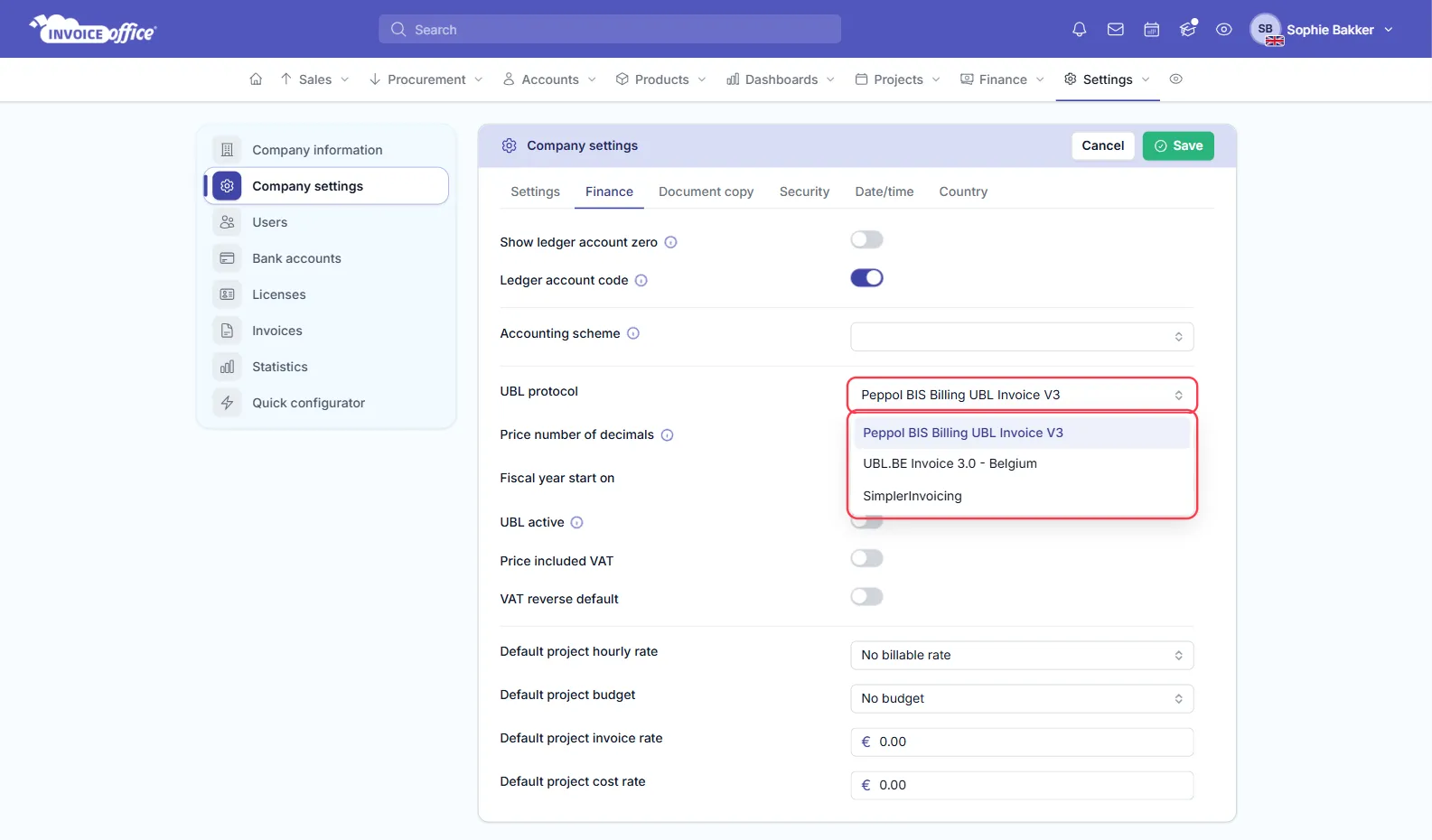
The format your e-invoices go out in is set under Settings → Company → Company settings, on the Finance tab, under UBL protocol: Peppol BIS Billing UBL Invoice V3 (the default, for every country), UBL.BE Invoice 3.0 - Belgium or SimplerInvoicing (the Dutch SI-UBL profile).
How to register your company, add the identifiers to your customers and send your first e-invoice is explained step by step in how to set up Peppol e-invoicing.